

New cryptocurrencies are introduced almost daily and their value can grow exponentially from the beginning. At the same time, many were abandoned after the novelty and the market of the "honeymoon period", after which significant use was immediately made. Despite these newborn cryptocurrency market properties, it is clear that some of the statistical properties of the cryptocurrency market have stabilized over the years. The number of active cryptos, the distribution of the market share and the crypto diarrhea turnover remain predictable.
By adopting a mathematical perspective, we see a neutral model of the economy of cryptocurrency. This allows insight to be collected on the basis of clear empirical observations, regardless of the advantages and disadvantages of a crypto above the other. We used this research to discover the unique nature and important factors to understand how cryptococcus offers value to end users and long-term token holders.
- What if Ripple offers a unique advantage to companies in the branch outside the bank and other financial institutions?
- What if Bitcoin is almost not exclusively controlled by speculation?
- What if the Ethereum mining award is awarded to the company that receives it as payment and is picked up by the platform
Minerva advanced method
Minerva uses two advanced methods to increase and decrease OWL token requirements.The first method calls a new Minerva OWL token and puts it in the economy when the partner platform receives the token as payment method. The speed at which the current OWL token enters the economy is called the "rate of return". The return is directly proportional to the OWL price: if the price rises, the return increases. The remuneration percentage will increase in order to increase the total supply sufficiently to prevent a strong short-term price variation is achieved. When the pay percentage is greater than zero (0), a small part of the prize is sent to the contract in which they can be exchanged for the MVP token (Minerva Benchmark Protocol tokens) and the polling token. The inflation rate inherent rewards used to reward the platform is difficult to close by 10%.
The second method sterilizes Minerva OWL tokens when the price drops. Instead of a negative reward percentage, we maintain a system that prompts users to temporarily remove their OWL tokens from the economy. The user will exchange an OWL token for an MVP token that represents certain OWL tokens that can (or can not) be valued over a certain period of time. In any case, the price drops the MVP token that is sold, but the drastic price decreases at the time of purchase, the higher the potential valuation value of this token. This MVP certificate will later be exchanged for the original OWL tokens paid in addition to certain extra percentages. If there is a long-term decline where the MVP safe deposit funds are exhausted, the OWL token must of course repeat price stability.
Model distribution and delivery of mathematical models
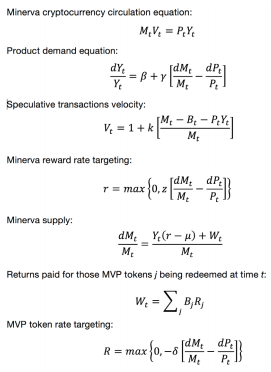 Modelvariabelen:
- Minerva Cryptococcus Supply, M
- Speculative transactions, V
- Export / product demand, Y
- Minerva price index, P
- Minerva per unit of real demand)
- Reward, r
- MVP token retour rate, R
- The sum of all Bi MVP token values circulates at time t, Bt
- The return rate for the Bi MVP token was determined upon purchase, Ri
Model parameters:
- The rate of output growth per period (t), β
- The elasticity of the output growth against Minerva's real stock increase, γ
- The elasticity of speculative transactions against the excessive supply of Minerva, k
- The sensitivity of the remuneration percentage to the real amount of money, z
- Sensitivity of MVP token return rate to Minerva real supply, δ
- Duration of MVP, T
- Insurance deposit Minerva, μ
- The mood system

Votes are based on the Schelling point method that is inspired by the SchellingCoin of Vituris Buterin, but modified to better manipulate (described below), to determine the estimated Minerva / USD conversion ratio. In addition to the normal transfer of OWL tokens, users can use a function that enables the transfer of tokens and polls in a single transaction. Since this "piggyback" the voice has minimal gas costs (transaction costs). In exchange for voting, voters will issue certain ballots related to their Minerva shares deposited for vote.
Minerva uses four main methods to prevent the manipulation of the voter:
- A deposit is required to choose. The deposit is in accordance with the effect of the vote of the voter on the "Minerva contract price" and the deposit determines the price received for voting. This deposit will be lost if the vote is considered invalid.
- A "voting chain" is used in this process. Votechain allows further assessment of the validity of the previous vote, because new sounds have been included. When a participant makes a vote about the current price, they are also asked to enter the price of the last selected moment. This vote is then compared with the previous vote and the votes that have been unlawfully assessed will lose their deposit. "Unauthorized noise" is defined as not falling between the 25th and 75th percentiles with sufficient sample size.
- If there are enough votes, all votes are rewarded, while at the same time only one percent can influence the contract price of Minerva.
- Open source voting and polling automation with the actual time log output as a failsafe mechanism. This protection is activated only if it is equipped with evidence of advanced attacks that occur on the Minerva Volatility Protocol.
In addition to the aforementioned controls for electoral manipulation, Minerva uses the following methods to avoid the Minerva Volatility Protocol price manipulation:
- The time at which the new contract price is randomly applied to avoid the level of predictability that allows the manipulator to know the optimal time to purchase the MVP token.
- Minor costs apply when dividing the MVP token or the required lag time is set to avoid market activity similar to speculative trading.
- The "MVP Door" applies where prices have to fall for a certain period before the possibility to buy an MVP token is available.
Platforms Incentives
Minerva offers a generous reward system for companies that accept it as payment. Upon receipt of Minerva OWL tokens, each company receives a bonus similar to a cash back incentive from a credit card. When Minerva OWL tokens are received from their customers, they are automatically liquidated.- Direct liquidity via API of Minerva-relevant trade fairs
- The elimination of chargebacks and exchange rates
- Extra protection against severe short-term price fluctuations
- Reverse transaction costs. We pay them, not vice versa
User benefits
When customers pay using the Minerva OWL token, companies have more flexibility to offer discounts. This is because, instead of paying transaction fees, Minerva platforms pay OWL tokens at the time of each approved transaction. Users can purchase OWL tokens from a stock exchange or market where they are traded, transfer them to one of the many ERC20-compatible portfolios and spend them on Minervaintegrated platforms.What is de Minerva Smart Money Alliance (MSMA) ?
The Minerva Smart Money Alliance (MSMA) is a proposed consortium of organizations that accept the OWL token payment or are strategically accepted with Minerva Technologies Sarl, a Luxembourg based blockchain software company and an older entity on the Minerva platform. We intend to work with different groups and individuals to optimize the exchange of value and the secure storage and transmission of sensitive.
Who builds Minerva?
Minerva Technologies Sarl, a Luxembourg-based blockchain technology company consisting of team members and consultants from around the world.
Where do the yields of the token crowdsale go?
As shown in the pie chart above, the token crowdsale is divided over multiple factions. 70% of the tokens are distributed among crowdsale participants. 10% is distributed among the founders and consultants. 10% is reserved for long-term operational costs and new progress. 5% is reserved to be distributed to new partnerships in the form of signing bonuses. The remaining 5% is reserved for and split between our promotional bounty and diligent bug bounty programs. All value that is transferred in exchange for OWL tokens during the crowdsale is the turnover of Minerva Technologies Sarl
Where will Minerva be used?
Minerva will be used on carefully selected platforms that are subject to strict control and transparency agreements. It is unlikely that we will consider using any platform with a <15,000 Alexa ranking.
Route map Minerva:

The Team of Minerva

Advisors

More Infomation
Website: https://minerva.comWhitepage: https://minerva.com/whitepaper.pdf
ANN: https://bitcointalk.org/index.php?topic=2072362
Facebook: https://www.facebook.com/MinervaToken/
Twitter: https://twitter.com/minervatoken
Telegram: https://t.me/minervachat
Author: haudhv
Bitcointalk: https://bitcointalk.org/index.php?action=profile;u=1814424


0 nhận xét:
Đăng nhận xét